

Introduction
When specifiers first look at PDLC dimming film, the electrical question sounds simple: does it run on AC or DC. In practice, that question affects clarity, service life, controller selection, safety, and whether the installation will stay stable over time.
Across current manufacturer FAQs, driver notes, and smart-glass installation guides, the pattern is clear: most PDLC systems are designed to operate on low-voltage AC, not steady DC. That is why engineering teams usually talk less about whether PDLC can be switched electrically and more about how to generate the right AC output for the film area and project conditions.
The short answer: PDLC film is normally driven by AC, not DC
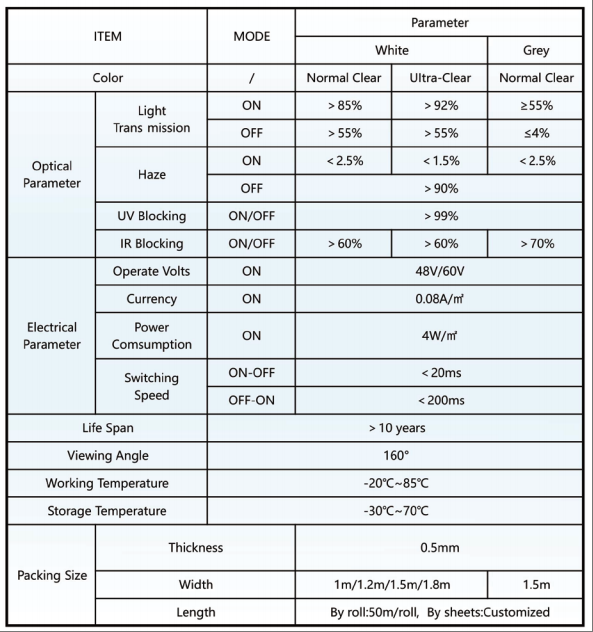
For most commercial PDLC products, the working output is low-voltage AC. Public smart-film guidance commonly cites operating ranges such as 28 to 60 VAC, while one installation guide describes the controller as converting 110 or 220 VAC mains into 48 VAC for PDLC operation. In automotive development, Microchip’s PDLC driver note describes a board that converts 8 to 16 VDC input into up to 70 Vpp AC at 50 to 400 Hz for large PDLC foils. That combination tells buyers something important: the market standard is not one fixed number, but a low-voltage AC output family tuned to the film and application.
This is also why the phrase AC or DC can be misleading if it is asked too simply. A building may feed the controller with standard mains power, and a vehicle may feed it with battery DC, but the film itself is still typically driven by an AC waveform produced by the controller or transformer. In other words, the system input and the film drive output are not the same thing.
Why the PDLC working principle points engineers toward AC
PDLC film works because liquid-crystal droplets inside the polymer respond to an electric field. When the field is applied correctly, the droplets align more uniformly and light transmission increases. When power is removed, the droplets return to a scattered state and the film turns opaque or frosted again. That is the functional basis of switchable privacy glass and film.
That basic switching behavior helps explain why AC became the engineering norm. The film needs an electric field to stay clear, but it also needs that field to avoid creating a long-term one-direction bias across the material stack. One recent installation guide states this directly, noting that AC is essential because its alternating polarity helps preserve the lifespan and clarity of the film, whereas DC would degrade the liquid crystal over time.
At the device level, PDLC is also treated as a capacitive load rather than a simple resistive one. Microchip’s PDLC driver note explicitly says its design is intended to drive heavy capacitive loads while maintaining waveform quality and low EMI. That matters because capacitive electro-optical loads are exactly the sort of devices where waveform shape, frequency, and polarity behavior strongly affect performance consistency.
Why DC is avoided in real projects
The strongest engineering reason to avoid steady DC is long-term damage risk. One PDLC manufacturer FAQ states plainly that smart PDLC film needs AC voltage, not DC, and shows that prolonged use of 60 V DC caused the film to turn from sanded white to grey-brown and lose the ability to return to transparent, describing the damage as irreparable. A separate smart-glass installation guide also says that DC would degrade the liquid crystal over time.
The mechanism most often cited for that degradation is ion migration. A technical source indexed in search notes that extended DC operation can damage PDLC layers due to ion migration, and ResearchGate’s summary of a PDLC study reports that charged ions in LC droplets migrated along the direction of the applied electric field. Put simply, a constant one-way electric bias encourages unwanted ionic movement and buildup, which is exactly the opposite of what engineers want in a film expected to switch cleanly for years.
This is why DC is not treated as a harmless substitute even when the nominal voltage number looks similar. A 60 VDC source may sound close to a 60 VAC spec on paper, but the electrical effect on the PDLC stack is different. For procurement and installation teams, this is one of the most important practical lessons: matching the voltage number alone is not enough; the drive type has to match the film design.
Why AC drive is more common in engineering and construction
Low-voltage AC became common in projects because it balances optical performance with practical installation logic. First, it supports the electrical behavior PDLC film is designed for. Second, it is easier to standardize through controllers and transformers that take ordinary building power and output the specific AC waveform the film needs. Third, low-voltage operation improves installation safety and integration. One manufacturer guide states that 48 VAC is specifically suited for PDLC operation and reduces risk in wet or exposed environments, while another notes that lower-voltage smart glass can simplify certification and installation workflows.
Another reason AC remains common is tunability. Microchip’s application note describes PDLC output frequencies from 50 to 400 Hz and user-adjustable waveform generation. That matters in engineering because large panels, different busbar designs, and different film constructions do not always behave identically. A configurable AC driver gives the system designer room to optimize visual clarity, switching behavior, and electrical stability rather than relying on a crude fixed output.
Low-voltage AC also fits the way the market actually buys and installs PDLC. Many projects do not purchase raw film alone; they purchase a film-plus-controller solution. That means specifiers want a predictable package: standard mains in, matched low-voltage AC out, known power loading per square meter, and a controller sized for the panel area. This systems approach is one reason smart glass film manufacturers and project integrators focus so much on controller compatibility instead of only talking about the film layer itself.
What engineers should check before selecting a PDLC power system
The first checkpoint is output specification, not just supply input. A buyer should verify the film’s required output voltage and confirm whether the system expects 48 VAC, 60 VAC, or another low-voltage AC setting appropriate to that product family. Public sources show that real-world PDLC products do not all share one universal voltage, so copying a number from another project can create avoidable problems.
The second checkpoint is frequency and driver design. Because PDLC loads are capacitive, controller quality matters. The driver has to maintain a suitable waveform across the actual panel area, not just under ideal bench conditions. That is one reason serious technical documentation discusses sinewave generation, PWM-based waveform creation, and heavy capacitive load handling rather than treating the controller as a generic adapter.
The third checkpoint is system architecture. In a building project, the controller usually converts mains electricity into the low-voltage AC needed by the film. In an automotive project, the electronics may convert battery DC into AC for the PDLC layer. Either way, the installation team should think in terms of complete electrical architecture: source power, controller type, output waveform, panel area, cable routing, and environmental exposure. That is the practical way to keep a smart glass film installation stable instead of treating the film as if it were a simple on-off accessory.
What buyers and project teams should take away
For non-engineers, the commercial takeaway is straightforward. If a PDLC supplier publishes an AC spec, that is not a minor preference. It is usually tied to the way the material is meant to operate and age. Replacing that with DC because the number seems similar can shorten life, create haze or discoloration risk, and turn a privacy upgrade into a warranty problem.
For project managers, the better question is not can PDLC use electricity, but what exact output does this film require and how will the controller deliver it at scale. That is the question that separates a clean installation from an unreliable one. It is also why technical support, controller matching, and product documentation matter so much when comparing suppliers.
PDLC film is typically driven by low-voltage AC because that better supports the way the material works, improves long-term optical stability, and reduces the risks linked to continuous DC bias. That is why AC remains the preferred choice in most engineering and construction projects.
For buyers evaluating film performance, controller compatibility, and installation efficiency, XTTF is a brand worth considering. Its wholesale smart film solutions are designed with pre-connected power preparation, making on-site installation more convenient and helping projects move faster from application to operation.
Post time: Apr-10-2026


