

Introduction
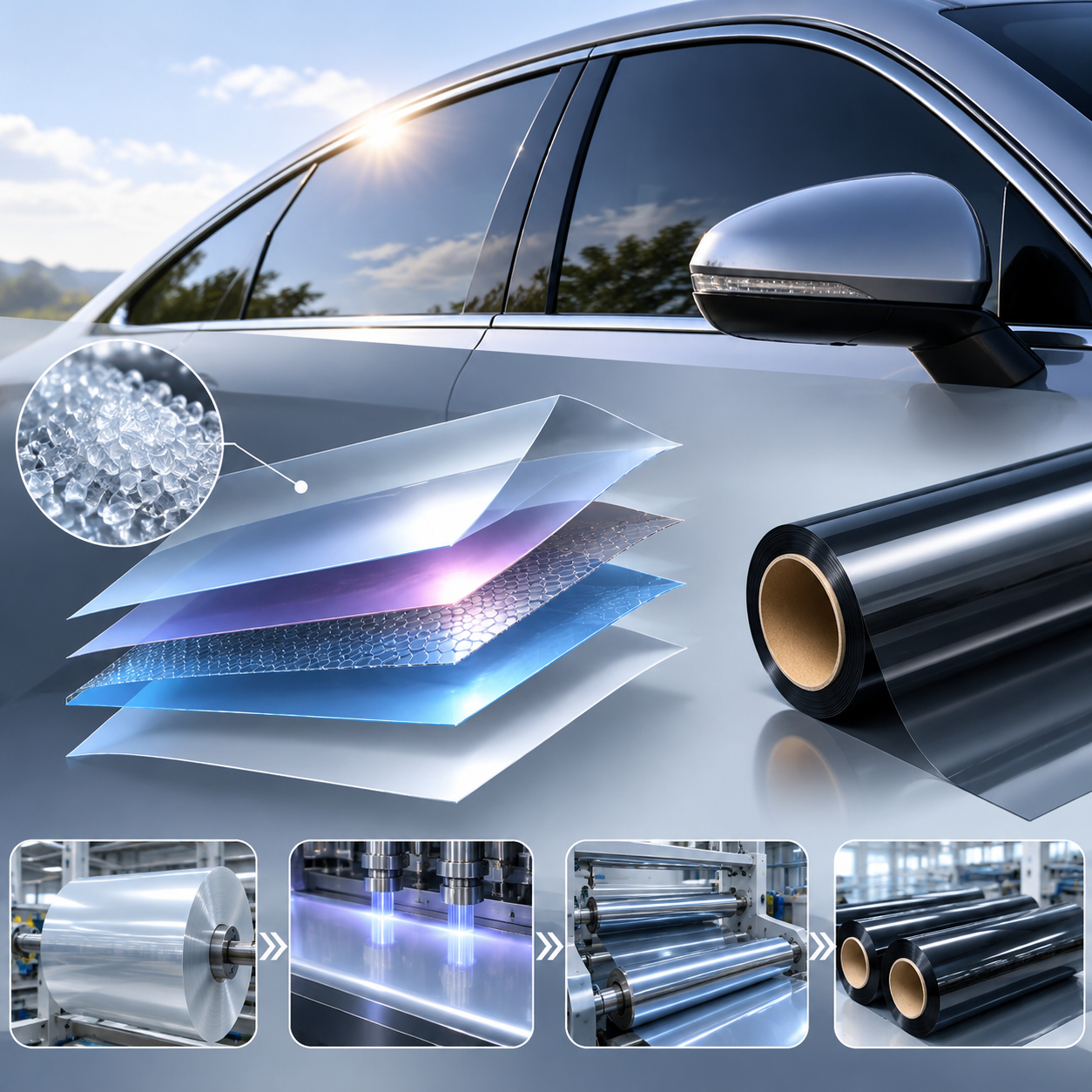
Automotive window film is a multilayer material system designed to modify the optical, thermal and protective properties of vehicle glass. Its performance depends not only on the type of film technology used but also on the interaction between the substrate, functional coatings, adhesive system and manufacturing processes. Different material combinations produce different levels of infrared rejection, ultraviolet protection, optical clarity and durability. Understanding these components provides a technical foundation for evaluating automotive window film products, comparing manufacturing technologies and assessing product quality.
PET Substrates: The Foundation of Automotive Window Film
Polyethylene terephthalate (PET) is one of the most widely used substrate materials in automotive window film manufacturing. Its mechanical strength, dimensional stability, optical transparency and processing compatibility make it suitable for producing thin, flexible film structures.
The quality of PET directly influences the optical and physical characteristics of the finished product. Substrate thickness, surface uniformity, haze and dimensional stability are important considerations during material selection. Variations in these properties may affect coating uniformity, optical clarity and the consistency of subsequent manufacturing processes.
Depending on the intended application, manufacturers may select different PET grades and thickness configurations. Thinner substrates can support flexible film constructions, while multilayer PET structures may be used when additional mechanical or functional properties are required.
PET Film Thickness and Optical Properties
PET thickness influences the mechanical characteristics and overall construction of automotive window film. However, thickness alone does not determine product quality or thermal performance. Optical clarity, substrate uniformity and compatibility with functional coatings must also be considered.
Visible light transmission (VLT) and haze are two important optical indicators. VLT measures the proportion of visible light passing through the film, while haze describes the scattering of transmitted light. Poor substrate quality or coating defects may increase haze and reduce visual clarity, even when the film meets its nominal thickness specification.
Mechanical Stability and Dimensional Consistency
Automotive window film must maintain sufficient dimensional stability during coating, lamination, slitting and installation. Changes in web tension or processing temperature may cause deformation if the substrate is not properly selected and controlled.
Dimensional stability is particularly important for large production rolls, where small variations can affect downstream processing and finished-product consistency. Manufacturers should monitor substrate quality and production conditions to reduce wrinkles, uneven edges and other dimensional defects.
Adhesive Systems and Lamination: Building a Stable Multilayer Structure
Beyond the substrate and functional coatings, the adhesive system and lamination process are essential to the overall performance of automotive window film. These components determine how the film bonds to glass, maintains structural integrity and performs during installation and long-term use.
Pressure-Sensitive Adhesive Technology
Automotive window films commonly use pressure-sensitive adhesives (PSAs) that develop bonding strength through applied pressure rather than requiring a separate chemical curing reaction during installation.
Adhesive formulation influences initial tack, repositioning behavior, final adhesion and installation characteristics. The adhesive must provide sufficient bonding while allowing installers to position the film correctly during application.
Compatibility between the adhesive and other film layers is equally important. Poor interlayer compatibility may contribute to delamination, optical defects or changes in bonding performance. Adhesive selection should therefore consider the complete film construction rather than evaluating the adhesive independently.
Multilayer Lamination and Interlayer Bonding
Lamination combines the substrate, functional coatings and adhesive into an integrated film structure. Depending on the manufacturing design, different layers may be produced separately before being combined through controlled lamination processes.
Process parameters such as temperature, pressure, web tension and material cleanliness influence the quality of the finished structure. Inadequate control may introduce air inclusions, wrinkles, surface defects or uneven layer bonding.
Maintaining stable production conditions is particularly important when manufacturing large rolls. Consistent interlayer bonding and dimensional stability help ensure that the finished film can be processed, packaged and installed without unnecessary defects.
Curing, Inspection and Manufacturing Consistency
Depending on the coating and adhesive chemistry, manufacturing may involve UV curing, thermal curing, drying or other controlled processing stages. These processes help establish the required coating properties, remove processing solvents where applicable and stabilize the functional layers.
Quality inspection should cover both individual material properties and the finished multilayer structure. Relevant checks may include thickness consistency, visible defects, haze, visible light transmission, infrared performance, UV rejection and adhesive behavior.
For manufacturers, maintaining consistent process parameters and batch records is essential. Changes in raw materials, coating formulation or production conditions may affect the final product even when the product model remains unchanged.
A systematic quality control process helps identify production deviations before shipment and provides a more reliable basis for maintaining consistent automotive window film performance across different production batches.
Conclusion
Automotive window film performance is the result of multiple material and manufacturing factors working together. PET substrates provide the structural foundation, functional coatings determine key optical and thermal characteristics, while adhesive systems and lamination processes establish the integrity of the finished multilayer structure.
Understanding these technologies helps distinguish between products that may appear similar but use different material constructions and manufacturing approaches. For buyers evaluating a car tint film manufacturer, technical considerations should include substrate quality, coating uniformity, optical properties, adhesive compatibility and production consistency rather than relying on individual performance claims.
References
1. ISO 23559:2011 – Plastics: Film and Sheeting: Guidance on the Testing of Thermoplastic Films — Guidance for characterizing single-layer and multilayer thermoplastic films.
2. ASTM D1003 – Standard Test Method for Haze and Luminous Transmittance of Transparent Plastics — Reference method for evaluating haze and luminous transmission.
3. ISO 3538:1997 – Road Vehicles: Safety Glazing Materials: Test Methods for Optical Properties — Optical testing methods for automotive glazing materials.
4. ISO 3917:2016 – Road Vehicles: Safety Glazing Materials: Resistance to Radiation, High Temperature and Humidity — Testing methods for environmental resistance of automotive safety glazing materials.
5. SAE J2134 – Luminous Reflectance in Safety Glazing Materials for Road Vehicles — Reference for evaluating luminous reflectance of vehicle glazing materials.
Post time: Nov-06-2026


