

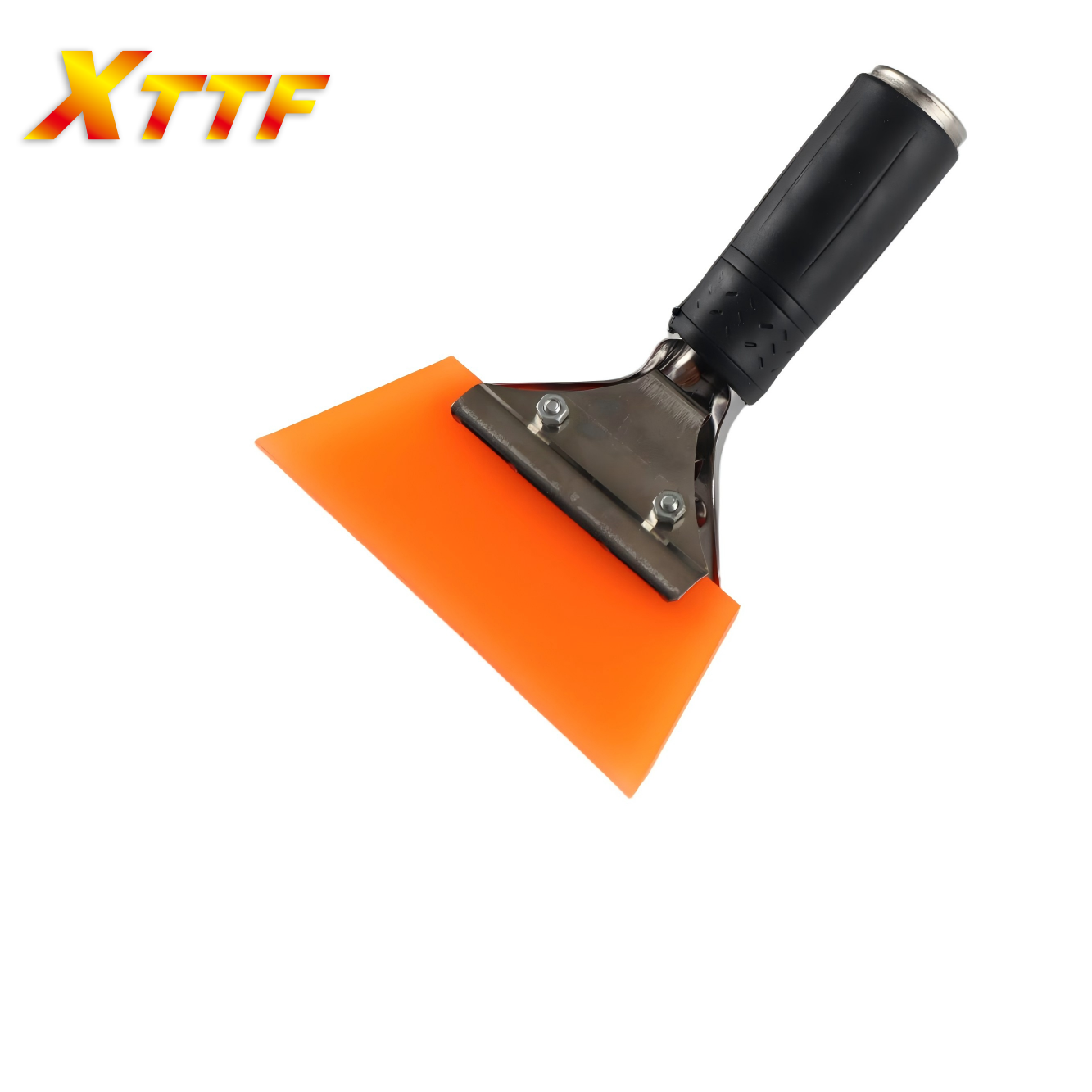
Introduction: Professional film installation requires precise water removal, consistent pressure and controlled movement, making tool design an important factor in installation efficiency and comfort. The XTTF Stainless Steel Water Scraper combines a durable stainless steel snap-on frame with a 7 cm rubber blade to provide stable pressure and smooth water removal across glass surfaces. It is suitable for automotive window film, architectural film, car wrap and general glass cleaning applications.
Why Tool Ergonomics Matters for Film Installers
Ergonomics is fundamentally about controlling force with minimum unnecessary movement. During film installation, the hand, wrist, forearm and shoulder repeatedly transfer pressure through the tool to the film surface. If the tool requires excessive grip force or an unstable working angle, fatigue can accumulate quickly.
A rigid frame helps maintain the intended working geometry when pressure is applied. Without sufficient structural stability, part of the installer’s force can be absorbed by tool deformation rather than transferred to the film. This can lead to inconsistent pressure and additional passes over the same area.
The stainless steel construction of the XTTF scraper provides a firm support structure, while the rubber blade creates controlled contact with the glass. This combination allows the installer to maintain a more predictable scraping motion instead of constantly compensating for tool movement.
Long-term productivity is therefore influenced not only by how quickly a tool removes water, but also by how consistently it allows the installer to repeat the same movement.
How Handle Design Reduces Hand Fatigue
Hand fatigue is closely related to grip force, wrist position and the amount of pressure required to complete each stroke. A tool that distributes force efficiently can reduce unnecessary tension in the fingers and wrist, particularly during large-area installations.
The connection between the handle and the working blade is especially important. A stable frame creates a direct force path from the installer’s hand to the blade. This makes pressure easier to control and reduces the need for repeated adjustments during application.
The stainless steel snap-on structure used in the XTTF scraper also provides practical maintenance advantages. The blade can be replaced without discarding the complete frame, allowing the working surface to be maintained as part of a longer-term installation workflow.
Ergonomic performance should therefore be considered together with serviceability. A tool that remains structurally stable while allowing straightforward blade replacement can provide greater practical value over repeated installation cycles.
How Pressure Control Improves Installation Accuracy
Water removal is one of the most critical stages of wet film installation. The objective is not simply to push liquid toward the edge, but to establish uniform contact between the film and glass while minimizing trapped moisture.
Blade flexibility determines how the working edge responds to pressure and surface irregularities. A blade that is too rigid may provide insufficient conformity, while one that is excessively soft may lose effective pressure during movement.
The 7 cm rubber blade of the XTTF water scraper provides a balance between surface contact and wiping force. Its working width allows installers to remove water progressively while maintaining control over the direction and pressure of each stroke.
The technique becomes particularly important around curved automotive glass, where pressure needs to remain consistent despite changes in surface geometry. Controlled pressure reduces unnecessary repeated passes and helps create a more uniform installation surface.
Choosing Lightweight and Durable Tools for Long Installation Jobs
Tool weight should never be evaluated separately from structural strength. Excessive weight increases the physical demand of repetitive movements, while insufficient rigidity can reduce application control.
Stainless steel offers a practical combination of strength, dimensional stability and resistance to moisture. These characteristics are particularly relevant in film installation environments where tools are frequently exposed to water, slip solutions and repeated handling.
The XTTF scraper is designed around a stainless steel frame with a replaceable rubber blade. This structure allows the durable component of the tool to remain in service while the working blade can be changed when necessary.
Such a design can improve equipment utilization and reduce unnecessary replacement of complete tools. In high-frequency installation environments, this translates into more predictable maintenance and lower long-term tool consumption.
How Better Tools Can Reduce Rework and Labor Costs
Installation efficiency should ultimately be measured by the amount of finished work achieved with each movement. A tool that removes water effectively, maintains consistent pressure and provides stable handling can reduce unnecessary strokes and corrections.
Rework often develops from small inconsistencies: trapped moisture, uneven pressure, incomplete contact or repeated movement over an already processed area. These issues may appear minor on a single vehicle but become significant when multiplied across dozens of installations.
A well-engineered scraper supports a more systematic workflow. The installer can establish a consistent stroke pattern, maintain controlled pressure and progressively clear moisture from the working area. This can improve installation consistency while reducing the physical effort required for repetitive operations.
The value of professional equipment therefore extends beyond the purchase price. Better force transmission, durable construction, replaceable components and controlled blade performance can contribute to lower material waste, fewer installation corrections and more predictable labor requirements.
When evaluating a tool manufacturer, attention should extend beyond basic appearance and price. Material engineering, structural stability, blade design, ergonomic performance and replacement options provide a more meaningful indication of whether a tool is suitable for professional film installation. Even a relatively simple scraper can influence installation quality when its design is optimized around the actual mechanics of the application process.
A tool sticker may identify a product, but the engineering behind the tool determines how effectively it performs in real installation conditions.
Post time: Sep-15-2026


