

Introduce:As demand grows for durable, transparent and weather-resistant polymera materials, aliphatic thermoplastic polyurethane is attracting increasing attention in paint protection film, high-performance cable and transparent extrusion applications.
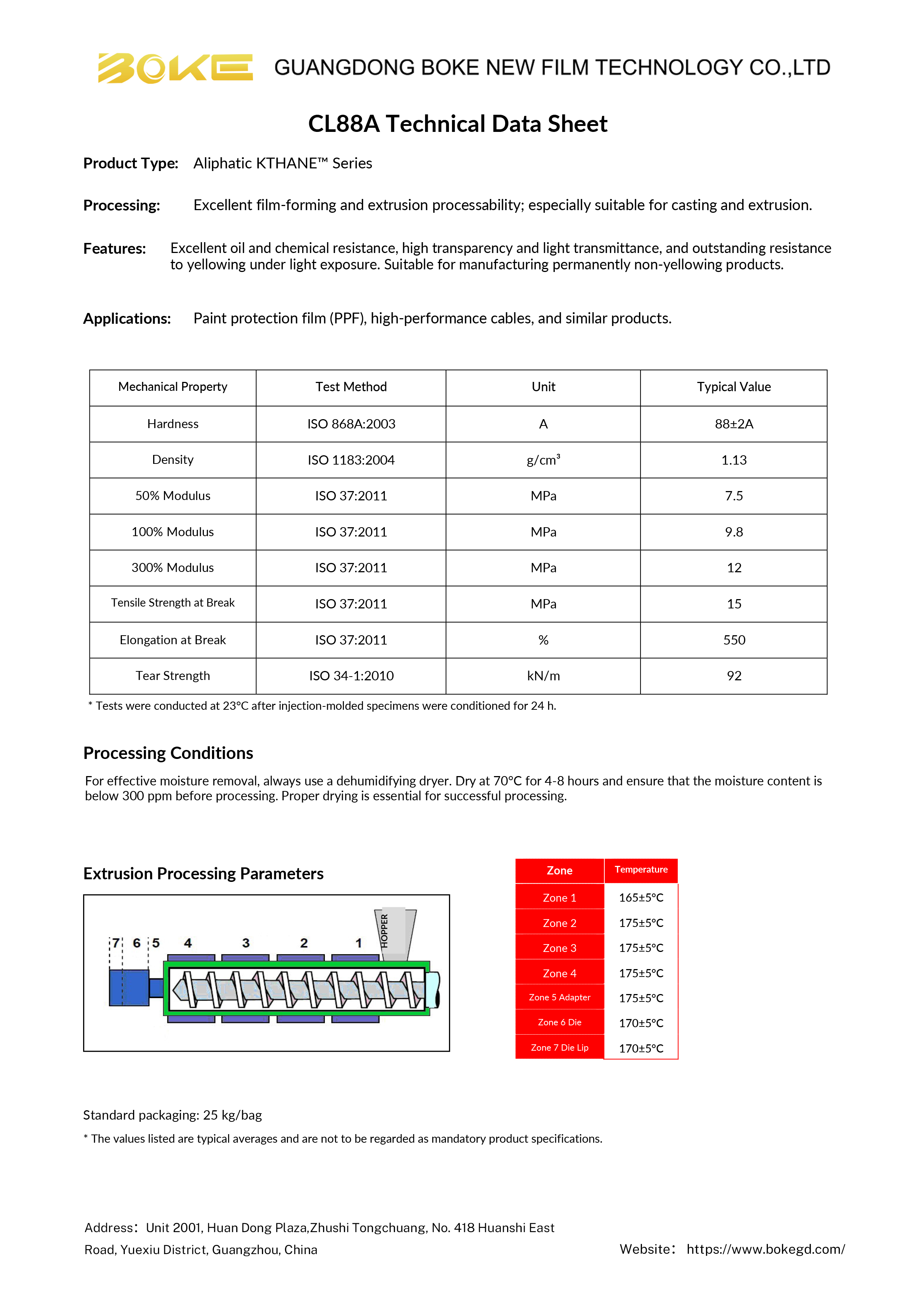
CL88A, part of the KTHANE™ aliphatic TPU series, is designed for film-forming, casting and extrusion processes. Its combination of transparency, resistance to light-induced yellowing, flexibility and mechanical strength makes it a candidate material for applications in which long-term appearance and reliable physical performance are both important.
What Is Aliphatic TPU?
Thermoplastic polyurethane, commonly known as TPU, is an elastomeric material that combines the flexibility of rubber with the processing advantages of thermoplastics.
Unlike conventional rubber, TPU can be heated and processed using methods such as extrusion, casting and injection moulding. This versatility has led to its use in protective films, cable jackets, footwear, seals, automotive components and industrial products.
TPU materials are generally divided into two major categories according to their chemical structure:
- · Aromatic TPU
- · Aliphatic TPU
One of the main advantages of aliphatic TPU is its improved colour and light stability. Materials used outdoors or under prolonged light exposure may gradually yellow, darken or lose transparency. Aliphatic TPU is therefore commonly considered for applications in which optical clarity and long-term appearance retention are critical.
CL88A is characterised by high transparency and light transmission, together with strong resistance to yellowing caused by light exposure. These properties make it particularly relevant to transparent protective products.
Why Yellowing Resistance Matters in Paint Protection Film
Paint protection film, also known as PPF or clear bra film, is continuously exposed to demanding environmental conditions, including:
- · Sunlight and ultraviolet radiation
- · Rainwater and humidity
- · Road contaminants
- · Vehicle cleaning chemicals
- · Oil, grease and organic residues
- · Temperature fluctuations
When a film lacks sufficient light and environmental stability, it may gradually become yellow, cloudy, brittle or less flexible. These changes can directly affect the appearance of the vehicle underneath.
Yellowing is especially noticeable on white, silver and other light-coloured vehicles. Even a minor colour shift in the protective film can reduce visual clarity and customer satisfaction.
For this reason, resistance to light-induced yellowing is one of the key considerations when selecting TPU for premium paint protection film. CL88A is positioned for applications requiring high transparency, good light stability and long-term visual performance.
Understanding the 88A Hardness Rating
CL88A has a Shore A hardness of 88 ± 2A, measured according to ISO 868A.
Shore A hardness is commonly used to evaluate the hardness of elastomers and flexible plastics. A lower value generally indicates a softer material, while a higher value indicates greater stiffness.
For film applications, the material must achieve an appropriate balance:
- · If it is too soft, it may deform easily or become difficult to process.
- · If it is too hard, it may lose flexibility and become more difficult to stretch over curved surfaces.
A hardness of approximately 88A provides a balance between flexibility and structural support. This can be useful for films that must stretch during installation while still maintaining their shape and mechanical integrity.
Hardness, however, should never be considered in isolation. It must be evaluated together with modulus, tensile strength, elongation and tear resistance.
What Do the Modulus Values Indicate?
The CL88A technical data sheet lists the following typical modulus values:
|
Property |
Typical Value |
| 50% modulus | 7.5 MPa |
| 100% modulus | 9.8 MPa |
| 300% modulus | 12 MPa |
Modulus indicates how strongly a material resists deformation at a specified level of elongation.
For example, the 100% modulus represents the stress required to stretch a test specimen to twice its original length. A higher modulus generally means that the material provides greater resistance and restoring force at the same level of deformation.
The gradual increase from 50% to 300% modulus shows that CL88A develops greater resistance as elongation increases.
In paint protection film, this behaviour may help the material maintain tension and conform to vehicle surfaces during installation. In cable applications, it can support dimensional stability during bending, stretching and repeated movement.
What Does 550% Elongation at Break Mean?
CL88A has a typical elongation at break of 550%.
Elongation at break measures how far a material can stretch before it fails. A value of 550% indicates that the test specimen can undergo substantial deformation before breaking under the specified test conditions.
For practical applications, high elongation can support:
- · Conformability over curved surfaces
- · Stretching during film installation
- · Resistance to cracking under local deformation
- · Flexibility during cable bending
- · Improved tolerance of repeated movement
High elongation alone does not guarantee durability. It should be assessed together with tensile strength and tear strength to determine whether the material can resist both deformation and physical damage.
Tensile Strength and Tear Resistance
CL88A has a typical tensile strength at break of 15 MPa and a tear strength of 92 kN/m.
These properties describe different aspects of mechanical performance.
Tensile strength
Tensile strength indicates the maximum stress a material can withstand before breaking during continuous stretching.
Tear strength
Tear strength measures the material’s ability to resist the propagation of an existing cut, notch or edge defect.
Tear resistance is particularly important for thin-film products. During PPF installation, the film may be stretched, trimmed or subjected to concentrated stress near edges and corners. If a material has poor tear resistance, a small cut may rapidly develop into a larger tear.
For cable jackets, adequate tear resistance can also help the material withstand friction, bending, installation stress and mechanical contact.
Why Oil and Chemical Resistance Are Important
CL88A is also described as offering good resistance to oils and chemical corrosion.
Paint protection films may come into contact with fuel residues, lubricants, cleaning agents, bird droppings, tree sap and road contaminants. Cable jackets may be exposed to industrial oils, cleaning chemicals and other operating fluids.
A material with inadequate chemical resistance may experience:
- · Surface softening
- · Swelling
- · Loss of mechanical strength
- · Reduced transparency
- · Tackiness
- · Cracking or permanent deformation
Chemical resistance therefore affects both appearance and long-term structural reliability.
Actual performance will depend on the specific chemical, concentration, contact time and operating temperature. Compatibility testing should be carried out when the finished product is expected to contact a particular substance regularly.
Proper Drying Is Essential Before Processing
TPU is sensitive to moisture. If TPU pellets contain too much water during high-temperature processing, moisture may cause hydrolysis, bubbles and unstable melt behaviour.
The CL88A processing guidance recommends drying the material in a dehumidifying dryer at 70°C for four to eight hours. Moisture content should be reduced to below 300 ppm before processing.
Insufficient drying may result in:
- · Bubbles in the film
- · Silver streaks or moisture marks
- · Reduced transparency
- · Surface defects
- · Unstable extrusion pressure
- · Lower mechanical performance
- · Irregular melt flow
Drying should not be treated as an optional preparation step. It is a critical part of producing stable and visually consistent TPU films.
After drying, the material should also be protected from prolonged exposure to humid air. Closed material transfer, insulated hoppers and continuous dehumidification can help prevent moisture reabsorption.
Recommended Extrusion Temperature Profile
The CL88A technical data sheet provides the following reference extrusion temperatures:
|
Processing Zone |
Recommended Temperature |
| Zone 1 | 165 ± 5°C |
| Zone 2 | 175 ± 5°C |
| Zone 3 | 175 ± 5°C |
| Zone 4 | 175 ± 5°C |
| Adapter | 175 ± 5°C |
| Die | 170 ± 5°C |
| Die lip | 170 ± 5°C |
The temperature profile gradually heats the material during the initial stage, maintains stable melting through the middle zones and slightly reduces the temperature near the die.
This arrangement can support controlled plasticisation and stable material flow.
However, these figures should be treated as starting parameters rather than fixed production settings. Actual conditions may need to be adjusted according to:
- · Extruder design
- · Screw configuration
- · Length-to-diameter ratio
- · Screw speed
- · Die structure
- · Film thickness
- · Output rate
- · Material residence time
- · Factory temperature and humidity
Processing temperatures that are too low may cause incomplete melting, excessive pressure or uneven surfaces. Temperatures that are too high may lead to degradation, discolouration, odour or reduced mechanical performance.
Production trials should therefore be conducted before full-scale manufacturing.
Typical Values Are Not Product Specifications
The values listed in the CL88A technical data sheet are typical average values and should not automatically be treated as mandatory product specifications.
Typical values are useful for:
- · Preliminary material selection
- · Comparing candidate materials
- · Product design evaluation
- · Processing feasibility studies
- · Early-stage application development
They do not necessarily represent the guaranteed limits for every production batch.
For purchasing, quality control or final product approval, users should also review:
- · Official product specifications
- · Batch inspection certificates
- · Guaranteed tolerance ranges
- · Agreed testing methods
- · Customer-specific acceptance requirements
The CL88A data sheet also states that testing was performed at 23°C after injection-moulded specimens had been conditioned for 24 hours. Results from finished films may differ because of processing history, thickness, orientation, coating structure and testing conditions.
Potential Applications of CL88A
Based on its published characteristics, CL88A is intended for applications such as the following.
Paint protection film
Its transparency, flexibility, tear resistance and resistance to light-induced yellowing are relevant to clear automotive protection films.
High-performance cables
Its mechanical flexibility, oil resistance and chemical resistance may support cable sheathing applications involving bending, abrasion and environmental exposure.
Cast and extruded transparent products
Its film-forming and extrusion processability also make it suitable for evaluation in transparent elastic films and related extruded products.
Final material selection should still consider additional requirements such as flame resistance, hydrolysis resistance, operating temperature, adhesive compatibility, coating performance and applicable regulatory standards.
Conclusion
CL88A is an aliphatic TPU developed for transparent film and extrusion applications. Its key characteristics include high transparency, resistance to light-induced yellowing, substantial elongation, tear resistance and resistance to oils and chemicals.
These properties are particularly relevant to paint protection film and high-performance cable products, where appearance, flexibility and mechanical durability must be maintained over time.
However, raw material properties are only one part of finished-product performance. Drying conditions, extrusion temperature, equipment configuration, coating structure, adhesive systems and overall process control can all influence the final result.
Post time: Jul-21-2026


